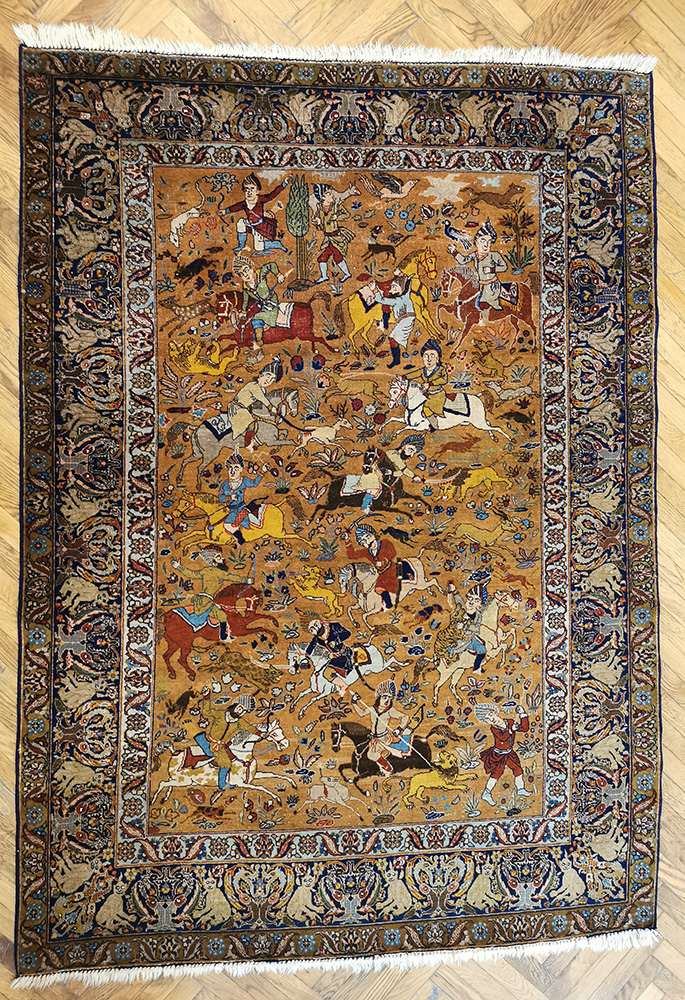
The hunting scene on this carpet is not merely decorative, but stems from a very ancient Persian cultural tradition of narrative imagery. Such motifs are often connected to stories from the famous epic Shahnameh, written around 1000 CE by the poet Ferdowsi. This epic recounts tales of kings, heroes, hunts, and battles, and is one of the most important foundations of Persian culture.
The central field of your carpet depicts a lively hunting scene. Horsemen hunt animals, including deer, gazelles, and likely lions or wild cats. In Persian tradition, hunting was not merely a sport, but a symbol of royal power, courage, and mastery over nature. Kings and heroes were often portrayed as skilled hunters, as hunting also signified military prowess and the ability to rule.
The composition of the scene is highly dynamic. The figures of horsemen are arranged across the entire surface, creating a sense of movement. Horses gallop in various directions, hunters draw their bows or hold spears, while animals flee through a stylized landscape of flowers and plants. This narrative style closely resembles that of Persian miniatures that adorned manuscripts during the Safavid Empire. Such miniatures were created in artistic centers like Isfahan, Tabriz, and Kashan.
The carpet’s color ground is golden-ochre, creating the impression of a sunlit landscape or an autumnal hunting setting. Against this light background, the figures are clearly visible. The riders’ garments are colorful—red, blue, green—emphasizing their status and individuality. The horses are depicted in various colors and poses, enhancing the sense of vitality and movement.
Surrounding the central narrative is a wide border with rich arabesques, palmettes, and botanical motifs. This frame functions similarly to a picture frame. While the center is filled with action and narrative, the border creates decorative balance and connects the carpet to the long tradition of Persian ornamental design.
Such figurative carpets are essentially textile narratives. Instead of abstract ornament, they depict a story or an idealized scene of a royal hunt. For this reason, collectors often regard them almost as textile paintings. Hunting motifs are particularly associated with the art of the Safavid period, when Isfahan was the capital of the empire and one of the world’s greatest artistic centers.
1. Theme and Narrative
The main motif is a classic hunting scene. The carpet functions not merely as a decorative object, but as a visual story.
-
Action and dynamism: The scene is full of movement—galloping horses, drawn bows, hunters with swords, and wild animals (lions, deer, gazelles) in flight or combat.
-
Courtly elegance: The hunters are dressed in traditional noble attire with turbans, indicating the aristocratic origin of the motif, which celebrates power, courage, and skill.
2. Color Palette
The colors are warm, earthy, and harmoniously balanced:
-
Dominant background: The central field is in a rich mustard yellow or golden tone, creating a sunny, desert, or steppe-like atmosphere.
-
Contrasting borders: Dark blue (indigo) and brown in the borders frame the light center and give it depth.
-
Details: The use of red, light blue, and green on the riders’ garments ensures that individual figures “stand out” from the background.
3. Composition and Pattern
-
The entire surface is filled with details. Among the larger figures, one finds small flowers, birds, and smaller animals, which is characteristic of fine Oriental carpets.
-
Intricate border: The outer borders are exceptionally complex. One can observe repeating motifs of faces or masks intertwined with vines, adding a touch of mysticism and ancient symbolism to the carpet.
-
Perspective: Similar to Persian miniatures, the perspective is “flat”—figures are arranged one above another rather than diminishing into the distance, creating a rich tapestry rather than realistic depth.
4. Craftsmanship and Materials: Wool
Knotting: This is very dense weaving, as the lines of faces and animals are quite precise.
The aesthetic of this carpet is maximalist, regal, and educational. It is an excellent example of how textile art interweaves with painting. In a space, such a carpet functions as a central artistic piece that draws the eye and invites detailed exploration of each individual knot.