

Interesting facts
Interview for Dnevnik, gallery owner Farzad Koushki


Carpets have held an extremely important place in Iranian culture and art for thousands of years, and their beauty is admired all over the world. A part of this art is also within reach in the very heart of Ljubljana, in the sales gallery and restoration workshop Farzad, where original Persian wallpapers are offered by Farzad Koushki, an Iranian living in Slovenia.
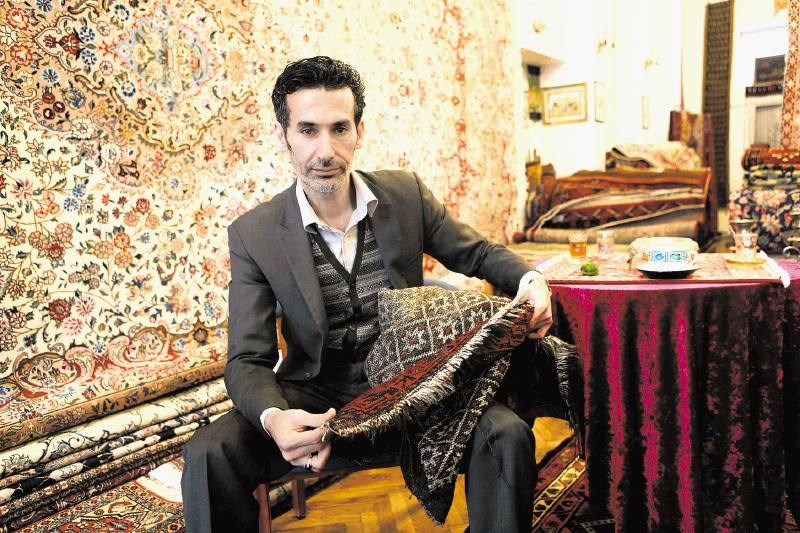
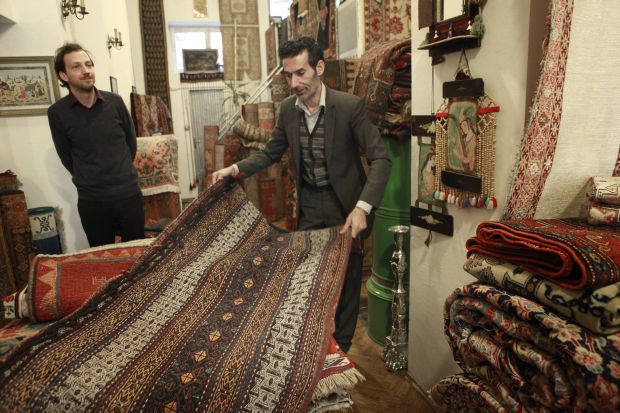 Photo: Luka Cjuha
With a unique character
An original Persian carpet is an ancient, noble art, which is mostly used as decoration today. In the thousands of years of development of carpet making techniques, perfection has been achieved in both technical and artistic terms. Therefore, the prices of Persian carpets range from approximately 50 euros for small specimens that can be placed on a chair or table, to several hundred thousand euros. For the most expensive one, which is currently available at the Farzad Gallery and is the largest carpet for sale in Slovenia (in the photo in the background), you will pay more than fifty thousand, as it is made of 12 million knots, which means that if it was created by the hands of four or five people, its production took more than two years. The price, of course, increases exponentially with size, but it also depends on who made the carpet, what material it is made of and how many identical specimens there are.
Real Persian carpets, however, gain value, both financially and culturally, over time, because their changing colors make them more beautiful year after year. For example, a carpet can increase in price several times over the course of a century. “You open bank accounts for your children, but we also make carpets for them, because it is an investment, a kind of deposit. Carpets are a valuable, elegant and extremely useful heritage that is passed down from generation to generation, while most other things are destroyed. A real Persian carpet never loses its value, because each one has its own unique character, which is reflected in the design and structure itself,” explains Farzad Koushki. Among other things, he owns a 150-year-old specimen that he would not sell for any price, and it will most likely soon be on display in one of the world’s famous museums.
Unlike the originals, fakes lose all their beauty after a few years, as they completely discolor, and the material often crumbles, because unlike real Persian carpets, which are made from the wool of a special breed of sheep that has oily and long microfibers, fakes are made from dry wool and short fibers. These have absolutely no material or artistic value. Most fakes come from China, India, and Nepal, and are mostly made by children under duress, while Iranian civil law strictly prohibits any work by children or minors. The interviewee points out numerous stories in which people posing as Persians or Orientals sell industrial wallpaper door-to-door under the guise of Persian carpets and charge thousands of euros for them, and scams also occur in shopping malls. “Recently, someone came to show me a carpet that he paid 15,000 euros for in one of the Ljubljana shopping malls, because it was supposed to be Persian and silk, but after examining it, I found out that it was neither Persian nor silk. It was cotton and therefore worth only a few tens of euros,” an Iranian expert offers one example of an otherwise widespread fraud.
Artworks that clean themselves
An original Persian carpet can also be recognized by the fact that it does not cause allergies, as the oily wool collects dust from the environment, which then does not rise back into the air while we walk around the room, thus acting as a kind of filter. However, the carpet still needs to be carefully maintained, as it is “art that we also walk on,” says Farzad Koushki, who also professionally cleans and restores carpets in his restoration workshop and gallery on Gornji trg, although older specimens, especially museum ones, are taken to Iran for restoration, where they are restored with the original wool and natural dyes in the master workshop in which they were made.
The interviewee advises that the carpet should be professionally cleaned and knotted every few years, but there are also a number of other things to keep in mind, such as ensuring that the carpet gets enough light, is not in a room that is too humid, does not place too many sharp objects on it, and is aired out often enough. It is also recommended to turn it over so that the prints of furniture are not visible, and that it is not worn down by walking in just one area. Farzad Koushki claims that a real Persian product is practically self-cleaning due to its high-quality wool, but otherwise, it is best to clean “floor paintings” simply by sweeping or, if necessary, with water – but not with the water from the tap, which is full of chlorine, but with spring water. However, any detergents or deep cleaning can destroy them.
In Farzad, where carpets are imported from various parts of Iran, including directly from nomadic tribes, certain carpets are rented out, mostly for cultural events. For example, Zakir Hussain, a master of Indian backgammon, wanted to play on them when he performed at the Union Hall in Maribor a few years ago.
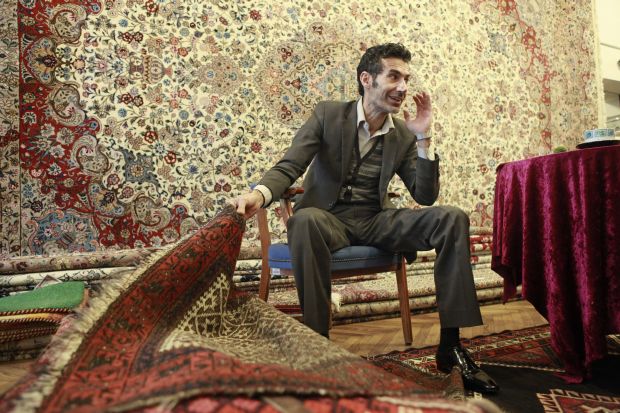
Photo: Luka Cjuha
They speak in symbolic language
Carpet making involves many steps, from shearing sheep and spinning to dyeing the wool (this is usually done with natural, plant-based dyes) and knotting, to straightening the wool and cutting the hairs, which must all be almost identical. In professional workshops in the city, each part of the process is carried out by a trained craftsman, while in nomads, one person or family carries out several steps of the production process. There are also quite a few differences, starting with the techniques. Nomads make smaller and lighter tapestries so that they can be carried with them when moving, and they knot them on folding looms that can be quickly packed away and taken away, as production is limited to the time spent at a stop.
For Iranian nomads, carpet making is a way of life, while in cities it is perceived as a well-paid profession that is learned like everyone else – in schools. Anyone can learn to be a carpet maker in Iran, regardless of previous education, and the education is financed by the state, which then buys the carpets from these craftsmen, as they would otherwise have difficulty selling them or would be forced to sell them at a much lower price. The state also finances the materials for many, as certain materials, such as real silk, which is sold by the gram, are extremely expensive. All these measures have an encouraging effect on this type of craftsmanship and the preservation of valuable cultural heritage.
Those who come from families with a long tradition of making Persian carpets, of course, learn all the necessary skills through the transmission of knowledge from their ancestors. Each such family and each place inserts different patterns into the tapestries, which are passed down from generation to generation and always speak in a symbolic language. While in urban workshops the patterns are created according to pre-drawn plans, the nomads indulge in greater spontaneity, which is why their products are less uniform. They mostly take inspiration from their own environment and thus decorate their carpets mainly with images of plants, animals and mountains, while the nomads living in the deserts use stars, the moon, geometric figures or patterns from their own imagination. The decoration thus ranges from flowers to archaic Mesopotamian forms.


